Nonprofit email templates
Appeals, impact reports and volunteer calls for charities, churches and community groups.
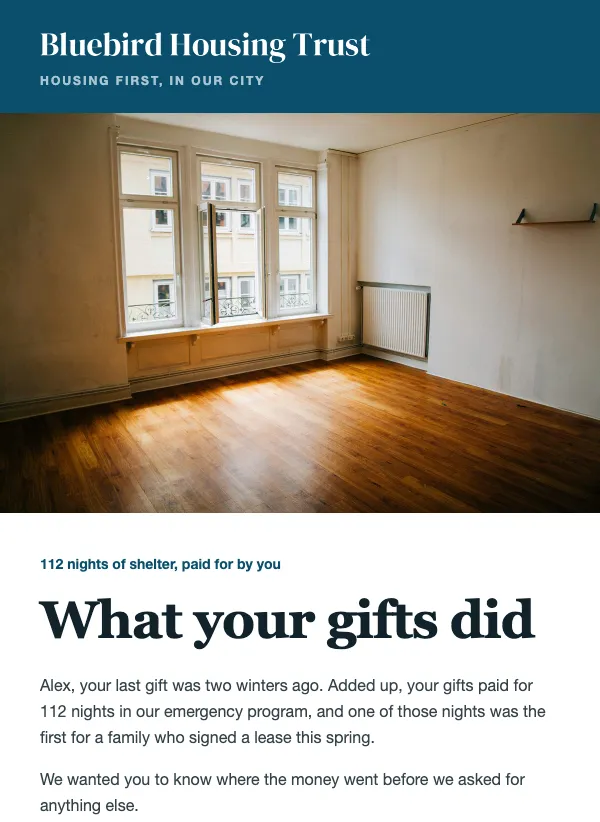 Lapsed donor email: what your gift did
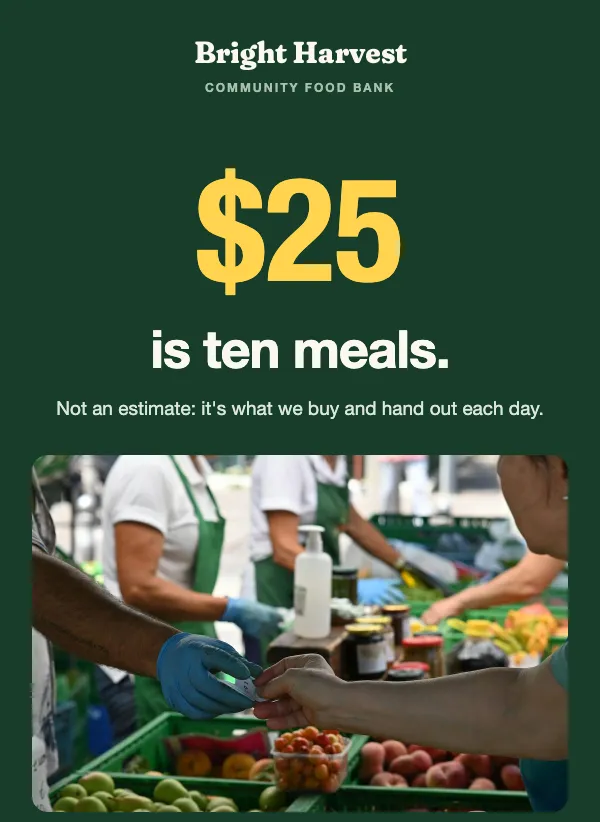 Nonprofit donation appeal letter
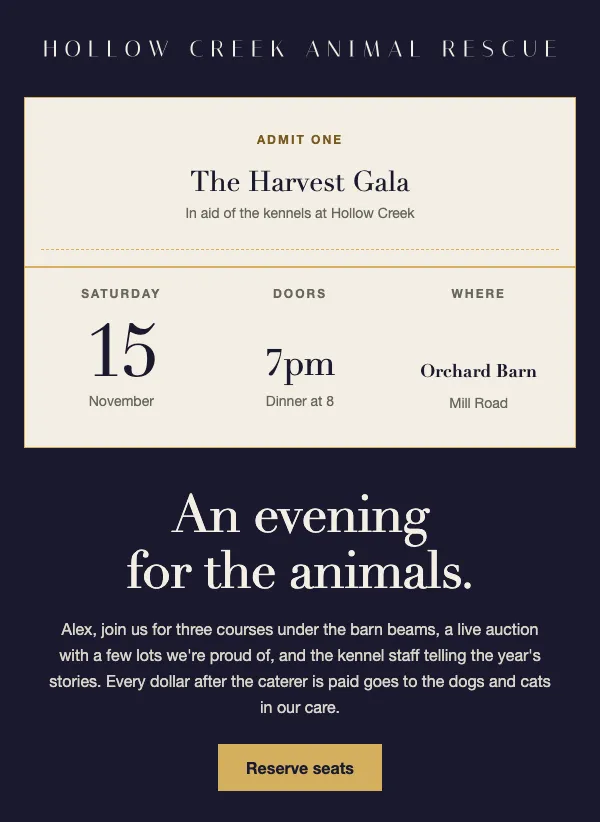 Charity gala invitation
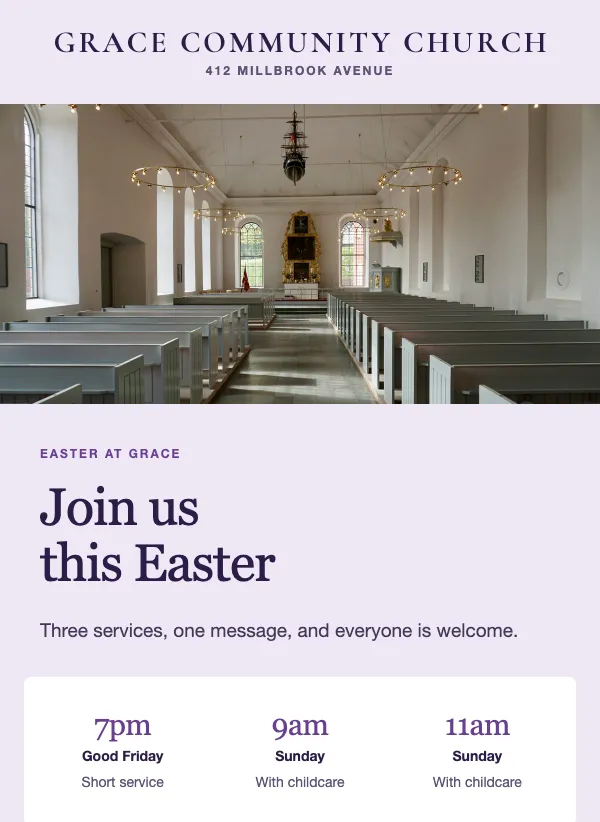 Easter service times email for churches
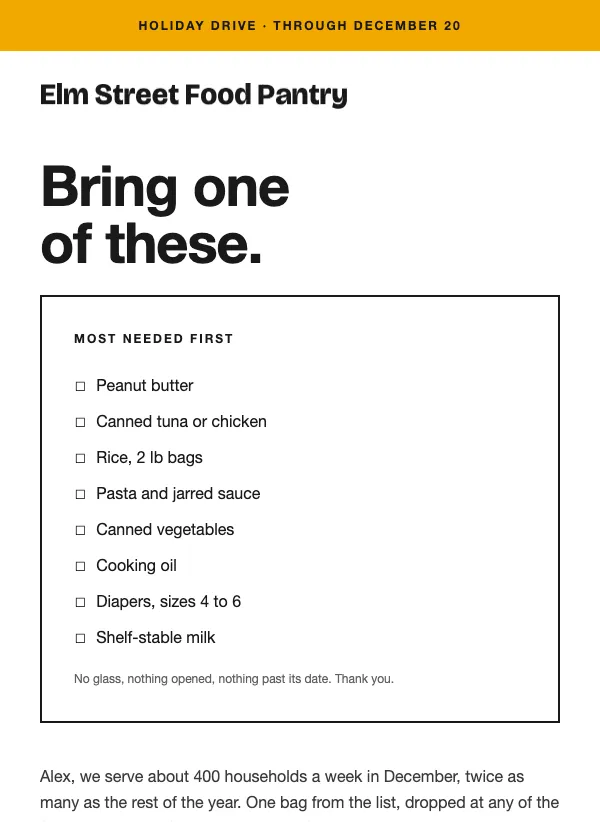 Holiday food drive email for food banks
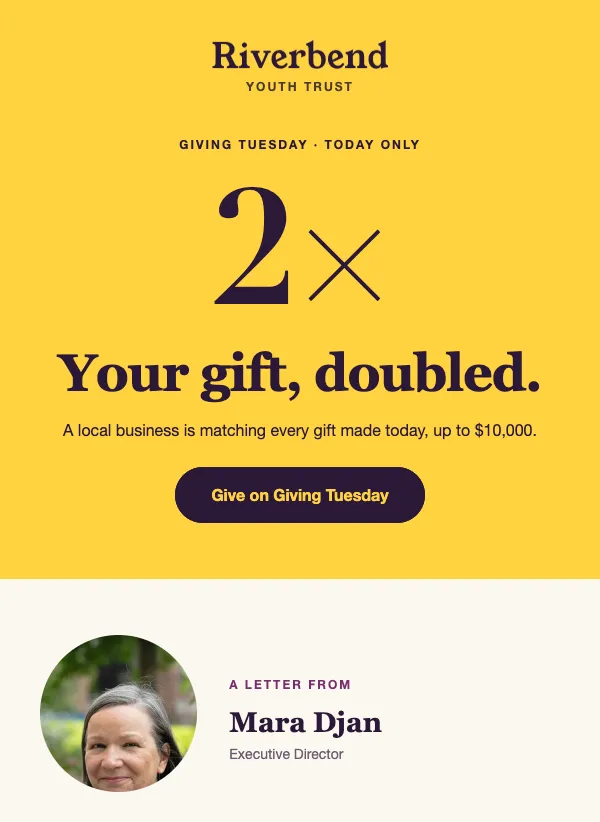 Giving Tuesday fundraising
 Nonprofit impact video
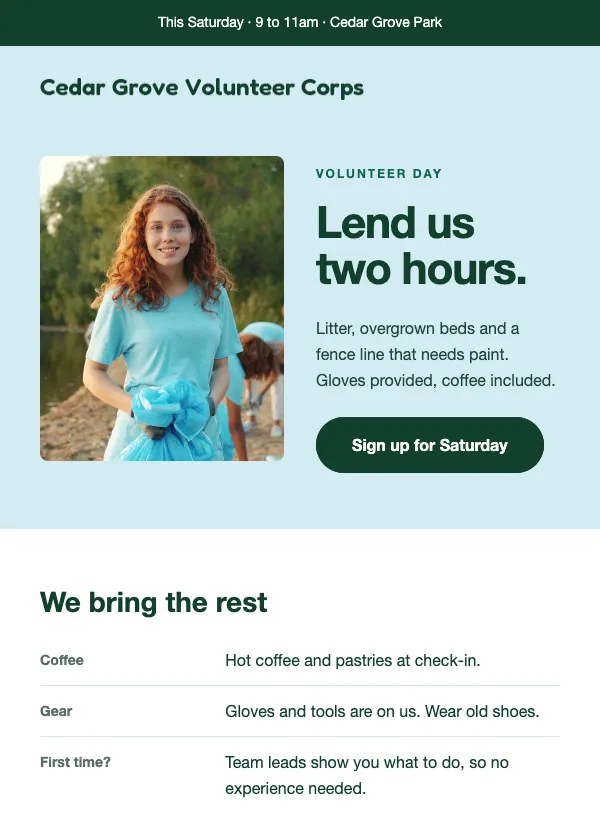 Volunteer day sign-up
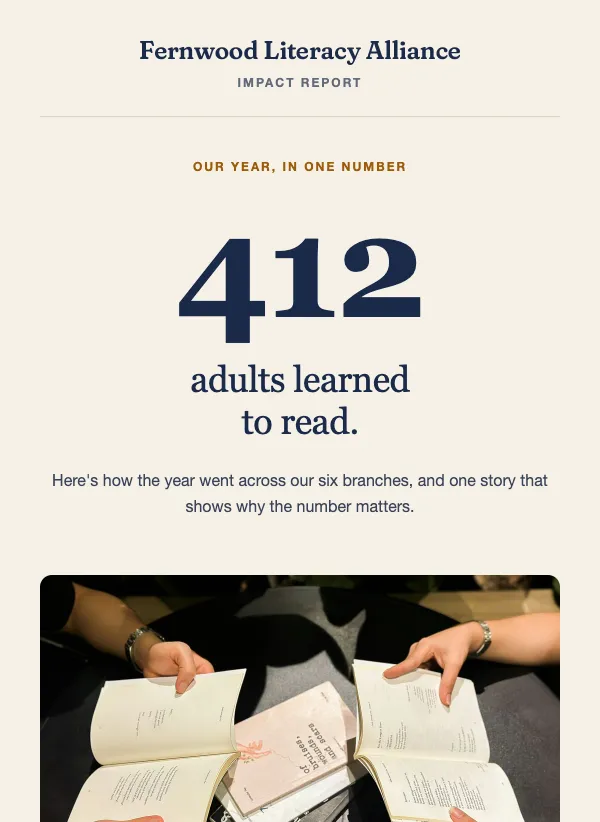 Nonprofit annual impact report
 Pride month community fundraiser
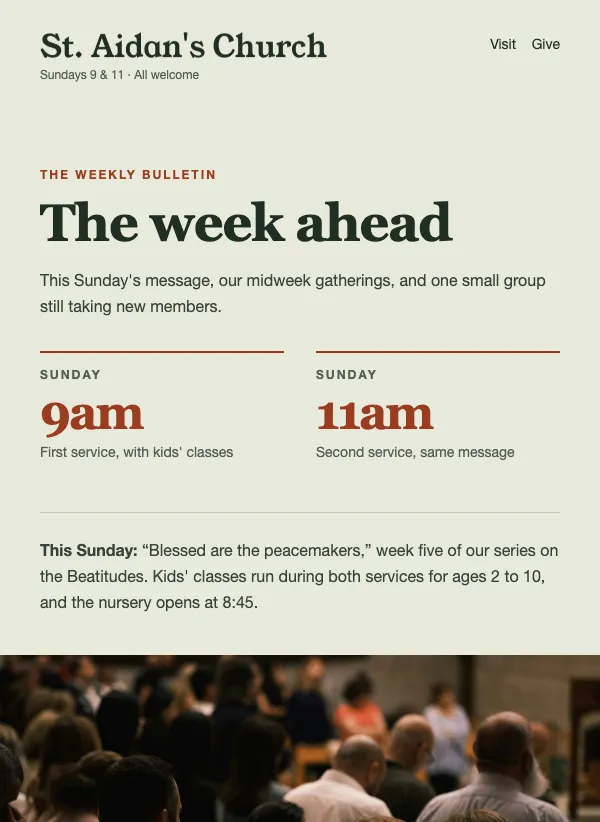 Church weekly bulletin
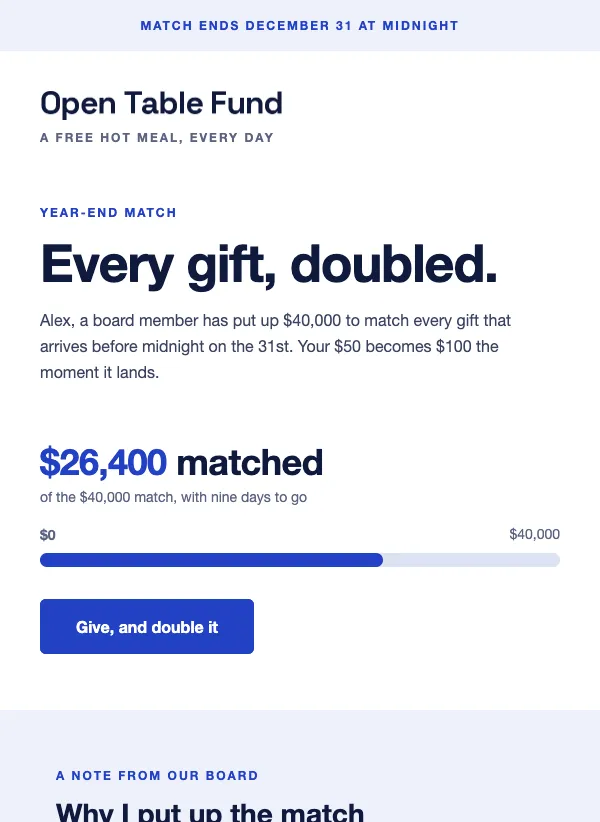 Year-end matching gift appeal
A nonprofit's year
Most nonprofits send three kinds of email across a year. Asks, when you need money or help. Reports, when you show what that money and help achieved. And news, which keeps your community close in between: a weekly bulletin, an event, a volunteer day, a story from someone you helped.
Giving tends to cluster at the end of the year, so many organizations send their main appeal in November and December. Spring and summer suit volunteer days and events. Your own dates matter too: the anniversary of your founding, a yearly fundraiser, a festival or a holy day your community marks.
Someone who signs up at an event or through your website should hear from you soon afterwards, with a warm thank-you and a short introduction to your work. You can set that up once as an automation that sends when someone joins your list. They are paying attention right then, and it sets the tone for everything that follows.
Asking for a gift
The most persuasive appeals tie an amount to a result. "What $25 actually does" promises to answer the question every donor has: what will my money do? The appeal template puts that answer in one big line, then a short letter from the director with a photo. Below it sit three amounts, each with something concrete it pays for, and one button to give.
Tell one story rather than many. One person, one family, one place you helped, in a few short paragraphs and a photo, does more than a page of statistics. Keep the button near the top as well as the bottom, for readers who are ready to give before they finish reading.
The Giving Tuesday template shows what a matched gift looks like: a supporter doubles every donation up to a set amount, and the email says so in the subject line. "A dollar-for-dollar match, today only" gives people a real reason to act now. Only say it when the match is real.
Make the button go to a donation page with the same amounts already shown, so nobody has to type a number. If you offer monthly giving, mention it under the button. A small gift every month adds up over a year.
Report back more often than you ask
Donors who hear what their gift did have a reason to give again. Yet many organizations only email when they need something. Send at least one report or thank-you for every appeal, and send it before the next ask.
An impact report does not have to be a long document. One number that matters, a short story and a photo is enough. "412 adults learned to read with us this year" says more in one line than most annual reports manage in ten pages. If you have a short film, the film template puts a still with a play button at the top, a few headline numbers below, and a subject line that says "Watch what your gift built this year".
Thank people properly, and specifically. "Your gift paid for this month's food deliveries" lands better than "Thank you for your support".
Volunteers and community
A volunteer callout works best when it is small and specific: a day, a time, a place and a clear task. "Two hours on Saturday, one cleaner park" is easy to say yes to. "We are always looking for volunteers" is easy to ignore. The callout template also answers the small questions that stop people coming, such as whether gear is provided, where to check in and whether they can bring a friend.
For churches, clubs and community groups, a regular bulletin is often the main email. The weekly parish template lists the Sunday services, the midweek groups and a way to help, with a short note for anyone new. The Easter one gives service times and what newcomers can expect, which helps visitors feel welcome before they arrive.
Subject lines for appeals and updates
Donors open mail that is about them and what they did. "Watch what your gift built this year" does that. So does "What $25 actually does", which promises a straight answer. Lead with the result, the amount or the person, and keep the organization's name for the sender line.
Avoid guilt and avoid vague pleas. "Please help us" tells the reader nothing. A specific line such as "Two hours on Saturday, one cleaner park" asks for something they can picture doing.
Photos of the people you help
A photo of a real person does more for an appeal than any graphic, but it carries a responsibility. Ask before you photograph anyone, and explain where the picture will appear. Show people as they would want to be seen: busy, capable, part of what is happening, not waiting for rescue.
Your volunteers and staff make good subjects too. A photo of the Saturday team at work, with their first names, shows supporters the people their money keeps going. Add your logo and colors to the template once, and spend the rest of your time on the story.
One tip for small organizations
You do not need a different design for every send. Pick one template for appeals and one for updates, set your logo and colors once, and reuse them. Supporters start to recognize the look, and each new email takes an hour to write instead of a day.
Keep a short list of the stories you can tell: a volunteer, a family, a project that finished. When a send comes round, you are choosing from a list instead of starting from a blank page. Ask the people in each story for permission first, and note it down.
Questions
Are the nonprofit templates free?
Yes. All of them are included on every plan, even the free one.
How do I write a donation appeal email?
Lead with what a gift does, tell one short story with a photo, and give two or three amounts with one button to donate. Keep it to a few paragraphs.
Can I add a donate button?
Yes. Any button can link to your donation page, so supporters can give in a few taps.
How often should we email our supporters?
Once a month is a steady rhythm for many charities, with a little more around your main appeal. Make sure most of those emails report back rather than ask.
Do these work for a church or community group?
Yes. There are weekly bulletin and service templates on this page, and every template opens in the drag-and-drop editor so you can adapt any of them.
When should I send my main appeal?
Many organizations send it in November or December, when people expect to give. You can write it early and schedule it to go out on the day you choose.